


What do you think about people who hear unbidden voices in their heads? Do you feel a twinge of unease, or ghoulish fascination? Do you slap them quickly with a label: crazy, mental, unhinged, dangerous? Do you pity them for the intrusive nature of this condition? How can they bear it? How can they think straight, with that interference? With that colonisation of their very mind?
***
One of my favourite public artworks in Edinburgh is the giraffe installation outside the Omni Centre at Greenside Place. Giraffes are one of my favourite kind of animal, they are so graceful and gentle, and so utterly weird-looking. The giraffes at the Omni Centre are made of recycled pieces of scrap metal, assembled in such a way as to form the long-necked creatures side by side, one an adult and the other its calf. I have been very fond of them ever since their arrival in 2005.

Some years ago however, they were overshadowed by an enormous LED advertising screen which stretches across the façade of the glass building. Anyone traveling through Picardy Place: pedestrians on the pavement, cyclists and people in cars and trams and buses; anyone shopping at John Lewis or attending the Playhouse Theatre; anyone going to St Mary’s Cathedral to worship or to the Conan Doyle for a pint – anyone’s attention will be drawn to the eyesore advertisements blaring out across the public space, long before noticing the elegant giraffes that are dwarfed in size by the obnoxious screen.

Well, then of course there are bus shelter scrolling ads. And billboard hoardings at roadsides and across railway bridges. And those constant adverts on the sides of the buses and trams themselves. It’s just the way it is, out there in the world.
***
Jerry Mander (1936-2023) was one of the original Mad Men. He lived the American Dream as a successful and wealthy corporate advertising executive in the 1950s and 60s. But before this path devoured his soul entirely, he rescued himself, and he shares his story in the introduction to his book Four Arguments for the Elimination of Television (1978.) The four arguments are still immensely relevant to this day:
1. Television mediates human experience;
2. Television colonises human experience;
3. Television has various negative effects on people; and
4. Television carries inherent biases.
To explore the depth of these arguments, one needs to read the book (it is still in print.) But one main theme it covers is the way that privately-owned mass media centralises control over our thought processes – literally taking up space in our minds and dictating the parameters and content of what we think about.
Of course, we are now far beyond just television. We have entered the digital age, a period which Naomi Alderman, in her book Don’t Burn Anyone at the Stake Today, describes as the third information crisis that humanity has experienced:
The previous two were the invention of writing, and the invention of the Gutenberg printing press. Digital communications technology is the third crisis. I think these prolonged crises aren’t just neutral technical improvements. I think they change us psychologically, socially and emotionally in profound ways that simply cannot be reversed.
Later she explores the difference between publicly-available information and privately-controlled information. She suggests that we surrender public platforms and spaces, such as libraries and the BBC, at our own peril. I’m sure there are many more scholars, historians, philosophers and activists that argue for the protection of the commons, but I’m going to reference just one more:
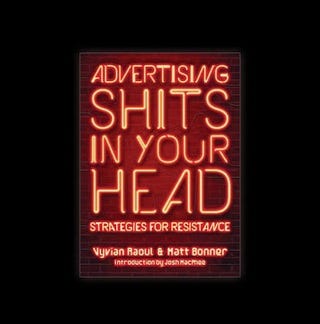
From the back cover: “Beginning with a rich and detailed analysis of the pernicious hold advertising holds on our lives, the book then moves on to offer practical solutions and guidance on how to subvert the ads.” How to subvert the never-ending cascade of branding and messaging and commerce, the intrusion upon our minds by all the hucksters and quacks who want to devour our souls entirely.
***
Which leads me back to my initial question. What do you think about people who hear unbidden voices in their heads? How can they bear it? How can they think straight, with that interference? With that colonisation of their very mind?
This really made me think about work I did in my MA Education dissertation on audience theory and the power of media over thought.
I was looking at film in classrooms, but one of the central tensions was much wider: are audiences passive recipients of messages, or active participants who interpret, resist and negotiate them? Early media-effects models imagined communication almost like an injection into a powerless audience. Later approaches, including Hall’s preferred, negotiated and oppositional readings, challenged that and recognised that people interpret messages through their own identities, histories, relationships and social environments.
What strikes me here is how strange our distinction between “acceptable” and “unacceptable” voices can be. We are understandably disturbed by the idea of a person experiencing voices they did not invite into their mind, yet we have largely normalised an environment in which corporations compete continuously for access to our attention. My dissertation also explored Marxist approaches to media, where the important question is not simply whether an individual audience member is suggestible, but who has the economic and institutional power to produce messages, circulate them repeatedly and define the available field of meaning in the first place.
I would not want to equate advertising with voice-hearing. They are clearly very different experiences, and doing so too neatly could risk turning somebody else’s distress into a metaphor. But I do think the comparison destabilises some assumptions about madness. We are all living with messages we did not request. We are all filtering, resisting, accepting, ignoring and sometimes internalising them. The difference is that some kinds of intrusion into consciousness are commercialised and treated as ordinary, while others become evidence that the person experiencing them is disordered.
That resonates with my own long experience of mental health services. I have often been interested in the boundary between what gets located “inside” an individual as pathology and what gets understood as a reasonable response to social conditions, trauma, poverty, power or environment. Mad Studies is particularly useful to me because it allows that boundary itself to become a question rather than simply accepting it as clinically settled.
My dissertation ultimately rejected the idea of the audience as either completely powerless or completely free. People have agency, but that agency operates inside environments structured by institutions, culture and economic power. I think the same caution is useful here. Perhaps the interesting question is not simply who hears voices?, but whose voices are allowed into our heads, who benefits from them being there, and which forms of mental intrusion society has decided to call normal?
As a voice-hearer, I do enjoy this comparison. One of the important factors that make sensations without stimuli more disturbing is that stripping away of the private world. As in, there is nowhere to go to be alone. I think the voyeuristic nature of advertising (to say, watches you watching it) does force people to confront that the public does not belong to the people anymore, although the sensation of an internal private world still exists to some degree. Even more on-the-nose in terms of forfitting the private life is that those with ‘smart’ appliances began seeing advertisements on their refrigerators (insert ‘feeding’ joke here).
Speaking of surveillance, I do think the social othering of the surveillance-state paranoid is going to thin a little given that many have invited cameras, voices, and listening devices into our home. In the cultural context where that is average, I sometimes wonder the difference between ‘delusion’/’paranoia’ and hyperperception/unconscious observation. I also wonder if the ‘referential delusion’ (e.g. direct broadcasting) will fall off of diagnostics given that algorithms and coding have made it so that much of what we are digitally exposed to is tailored to speak to us directly. At what point have we just been unconsciously predicting patterns and driven to a proportionate amount of distress? In a way, being othered as paranoid has started to look like othering the unsubmitting.