

Addressing “The Problem Child”

Names have been changed for confidentiality
Dear Frida and Leo,
Thank you for your email.
I am now quite angry with myself that I didn’t step in sooner to help, primarily by making it crystal clear to Carlos that: the problem is the world around him and absolutely not anything inherent to him. You might say:
“You are not the problem, the problem is the not-you”.
I saw him challenged by distractibility for two years, but more importantly I watched him suffer the iatrogenic harm created by totally unnecessary medicalisation that only worsened his condition and further undermined his sense of self.
I could have provided much more guidance earlier on. Unfortunately, I was deeply fearful of challenging the medical gaze. Education continues to be dominated by a - paradoxically - pathological transformation of children into objects of pathology. Challenging this normativizing discourse can often cause serious disagreements over the nature of man itself and, particularly in the UK, lead to significant doubts regarding your professional competence. Unfortunately, psychiatry continues to claim the status of a science despite meeting none of the requirements of objectivity that would give it that status. Hence Thomas Szasz’s fundamentally correct view that there are simply no biological markers possible for demarcating mental illness, namely because the construction of the disease entity (a social control function) precedes the construction of a biological explanation for that entity; the chicken (ADHD in this case) comes before the egg (alleged neurochemical “imbalances”). I was delighted to hear from Carlos that you had successfully proven that the drugs were, in many ways, causing the disease. I would encourage you to consider pursuing litigation against the psychiatrist, if you are able.
Please see below a copy of the exam Carlos sat last week. Please pay close attention to Source B as it was intentionally included to help students reflect on the fundamental ways in which their lives are affected by anachronistic temporal norms. These continue to be reinforced and unchallenged by the educational system. Ultimately, ADHD in particular is, in my view, better understood as a rational and indeed heroic resistance to temporal colonialism. The difficulty is that this condition is being compounded by the rise of technofeudalism (see the book by the same name by Yanis Varoufakis), which has transformed the human subject into a serf of cloudalist tech overlords, who have successfully commodified human play itself - the last remaining bulwark against total hegemony - by transforming it into distraction, into capital, into work. Thereby destroying the fundamental dichotomy of work/play - the true end of colonialism.
I would be very happy to mentor Carlos next year more closely, if he thinks that would be helpful. I have made suggestions to the school regarding a tutoring programme that should facilitate this further.
I hope you all have a great summer.
Best wishes,
Yishai
EXAM
Individuals and Societies
Key Concept: Communities
Related Concepts: Human Rights, Mental Health, Sustainability, Poverty
Time: 1 hour 30 minutes
Source A
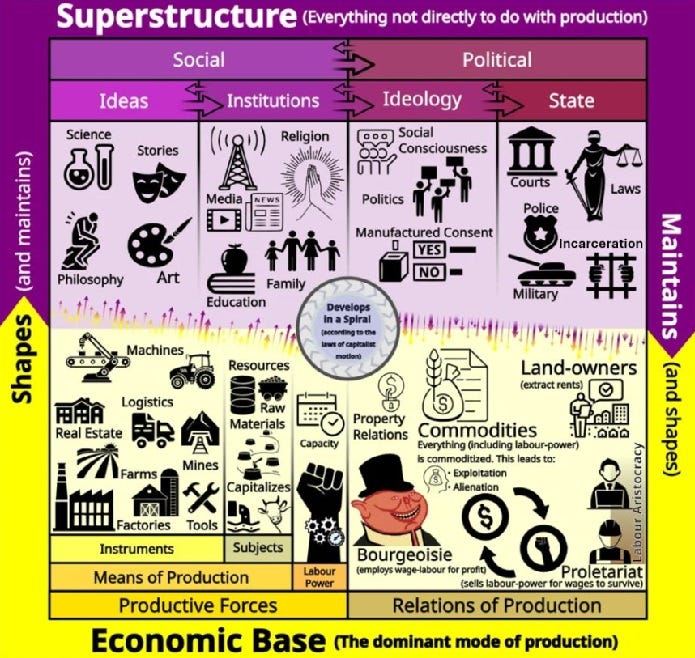
(Adapted from: Steelman, Alex. “A Detailed Model of the Base and Superstructure.” Reddit.com, 2023. Accessed 25 May 2026.)
In Marxist theory, base and superstructure are concepts that explain the relationship between a society’s economic foundation and its other social forms.
Source B
(Adapted from: Akhund, Marium. “Decolonizing Neurodiversity: A Critical Examination of Pathologization and Acceptance across Cultures.” Marium Akhund, 23 May 2025. Accessed 25 May 2026.)
Temporal norms in the West are deeply structured by the logic of industrial capitalism, punctuality, linear progression, and optimization. Executive dysfunction (a behavioural symptom that disrupts a person’s ability to manage their own thoughts, emotions and actions), often cited in ADHD literature, is interpreted as deviance from these norms. However, in circular time frameworks common to Indigenous epistemologies1, attention, memory, and planning are understood relationally, anchored to land, seasonality, and social interdependence. This challenges the universality of executive functioning criteria and calls for a pluralistic temporal ethics.
Capitalist time discipline, schedules, deadlines, optimization, is often incompatible with nonlinear neurodivergent time perception. Western capitalism slices time into commodities, punishing those who cannot keep pace. In Indigenous African and Native American cosmologies, time flows cyclically, in relation to land and ancestors. The so, called “executive dysfunction” of neurodivergent individuals may reflect a more embodied, relational temporality. The colonial construction of urgency is disabling to those who live by rhythm rather than productivity.
Source C
(Adapted from: Zheng, Robin. “What Is My Role in Changing the System? A New Model of Responsibility for Structural Injustice.” Ethical Theory and Moral Practice, May 2018, pp. 1–17, doi:10.1007/s10677-018-9892-8.)
Traditional theorizing about global injustice has been premised on a picture of individual moral agents bearing responsibility for particular actions because they exercise freedom and rationality in choosing to act one way rather than another. Recent thinking, however, has been characterized by a move away from agents to structures, as suggested by the term structural injustice itself. A structuralist approach rejects the conception of the liberal autonomous subject underlying the traditional picture of responsibility. It highlights instead the way in which social life is characterized by constant pressures constraining the range of agents’ possible actions. For example,corporations operate sweatshops because their profits and viability are threatened when their competitors cut costs, and governments in developing countries permit them because their attractiveness to foreign investors — vital for surviving in a global capitalist order — is threatened when they tighten labor regulations and others do not.
Very few of us would say that we live in a morally just world. Most of us are deeply concerned about some issue of pressing importance or other: poverty, unemployment, racial and sexual violence, or climate change, to name just a few. These are forms of structural injustice. Structural injustice is highly complex, with multiple causes and without easy solutions. Its defining feature is that it is not maintained purely through the biased attitudes or malicious actions of individuals, though such bias and malice undoubtedly exist. Rather, structural injustice is maintained through the behavior of ordinary decent people whose choices are constrained by existing social, political, economic, and cultural institutions. Racial and class segregation, for instance, is maintained as much by well-intentioned parents seeking the best school district for their children as it is by racist real estate agents or landlords.
Source D
(Adapted from: Heywood, Andrew, and Ben Whitham. Global Politics. Bloomsbury Publishing, 2023.)
Black and ‘intersectional’ feminist thinkers and activists emphasize the urgent need to understand and address gender, race, and class (and very often, sexuality, disability, and other issues) as key political issues and planes of social existence through which people experience ‘structural’ or ‘systemic’ forms of inequality, oppression, exploitation, and violence. In other words, they highlight the intersectional and constitutive role of not simply ‘beliefs in’ but rather social structures of racism, classism, capitalism, homophobia, misogyny, and other oppressions, in people’s experiences of power and (in)equality. They view the struggle for a more just social order as the struggle against these systemic oppressions and inequalities. They wish to draw attention to widespread, systemic social trends that saturate and structure everyone’s experiences of social life. What bell hooks calls ‘white supremacist capitalist patriarchy’, is not about ‘identity politics’ in the sense of a politics emerging from one’s own, narrow, personal experience, but rather about the social structures of inequality and oppression that are coded into the very political ‘DNA’ of majority-white, Western societies. The attention such intersectional feminists demand we pay to the voices of ‘lived experience’ are not about individualizing our understanding of our political interests, but rather about socializing our understanding of our individual circumstances and experiences.
1. Using Source A, identify what can be observed about the nature of the global socioeconomic system.
2. With explicit reference to Source B and one example you have studied, explain the major challenges created by our global system.
3. Compare and contrast the views of Source C and D on the importance of structure to social problems.
4. Using at least three sources and your own knowledge, to what extent does the global system harm the well-being of communities?
 | A guest post by
|
I invite the reader to complete the exam and send me your responses! Q1 = 3. Q2 = 4. Q3 = 6. Q4 = 12. TOTAL = 25.